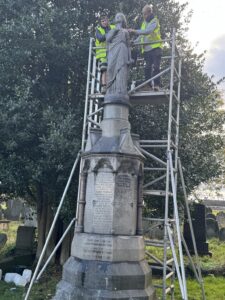
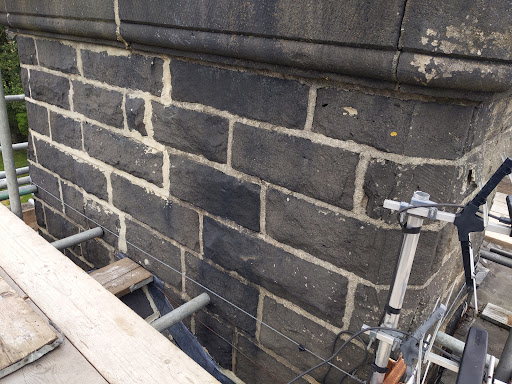
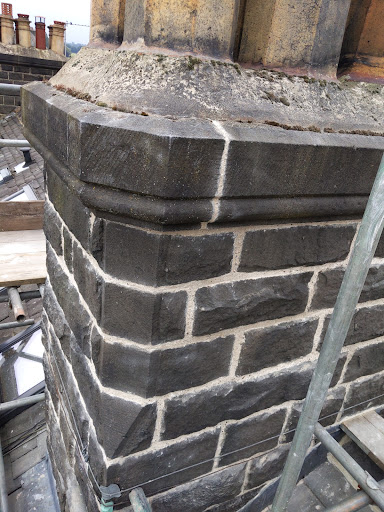
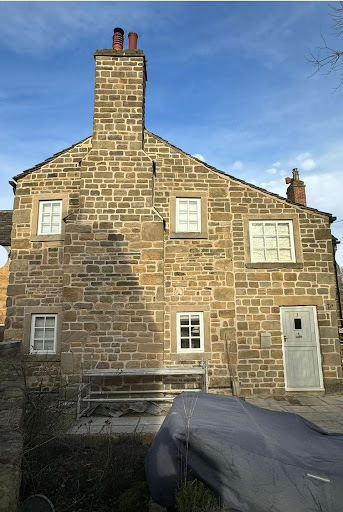
Making old stone look new is usually the wrong conservation objective. Tool marks, weathering, patina and previous repairs can be evidence of a building’s history. Cleaning should have a defined purpose and retain that evidence, rather than remove the surface until the masonry looks freshly cut.
Start with the cause of the change
Staining may come from runoff, metal corrosion, salts, pollution, coatings or biological growth. Each calls for a different response. Moss beside a leaking downpipe is a reason to investigate the water source; it is not proof that the whole wall needs cleaning.
Assess whether the change is stable, harmful or merely visual. The stone’s condition matters more than the amount of apparent dirt. A sheltered black crust and a friable exposed face can require different decisions on the same building.

Keep useful historic surfaces
Aged masonry is not defective simply because it is uneven in colour. Cleaning can remove original tooling, open pores, reveal lighter patches or dislodge already weakened grains. Consolidation, a local repair or leaving the surface undisturbed may be more appropriate.
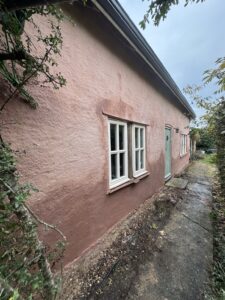
Likewise, surviving limewash, render and shelter coats may be historic protective finishes. Investigate them before removal. Exposing stone that was intended to be coated can increase weathering rather than improve the building.
Trial before treating a whole wall
Agree the reason for cleaning and identify representative test areas. Check permission requirements before trials on listed fabric. Record the method and inspect the test after it has dried; a wet surface can conceal colour changes and grain loss.
The acceptable outcome may include some residual staining. Matching a new stone repair is not a reason to strip sound old masonry back to the same colour. Select and finish the repair to suit the surviving work instead.
DOFF, TORC and other methods
DOFF can soften certain deposits and paint systems using superheated water and steam. Pressure, temperature, working distance and exposure time must be established by trials. The method can still damage weak stone, joints or coatings.
TORC is a controlled abrasive process using air, water and granulate. Its suitability depends on the stone and deposit. Manual cleaning, poultices or suitable paint-removal products may be preferable, or no cleaning may be necessary. There is no universally safe system for all old stone.
Different stone needs different assessment
Yorkshire’s sandstone, gritstone, limestone and mudstone do not behave identically. Even stones with the same broad name can vary in bedding, cementation, porosity and weathering. A hard-looking stone may have a fragile surface or vulnerable detail.
Replacement stone should be matched for relevant physical properties and laid with the correct bedding orientation. Where a repair mortar or shelter coat is considered, agree trials and compatibility rather than treating it as a cosmetic filler.
A record and a maintenance plan
Keep the agreed samples, photographs and specification. Repair the defects that created damaging wetting and inspect those details in future. Our conservation masonry work aims to retain original fabric and repair only where necessary. Ask us about the condition of your stonework before planning a clean.
Further reading: SPAB: preventative maintenance; Historic England: care of buildings and biological growth; Historic England: listed building consent.